
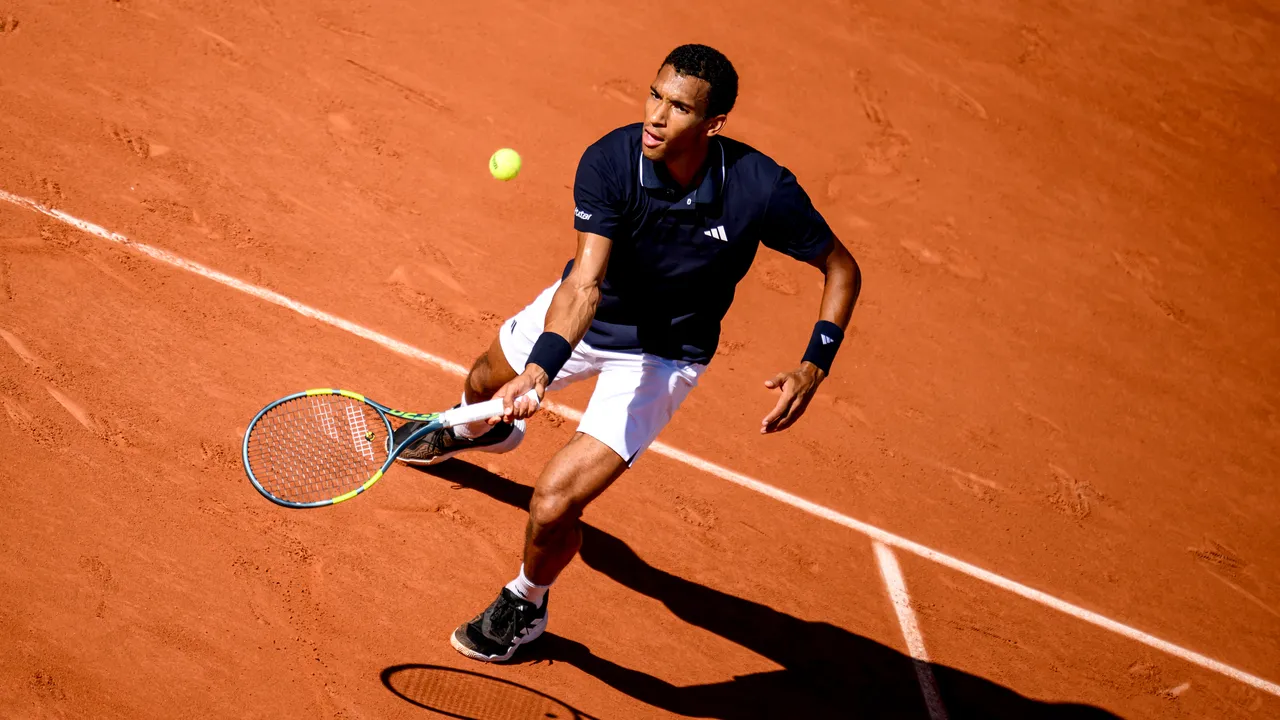
More than one tennis pundit has called the 2026 French Open a “chaotic Slam,” and for good reason: even the boldest of gamblers wouldn’t have bet on the men’s singles field at this year’s Roland-Garros shaking out as it has. It has been scrappy and hot (Paris experienced an extended heat wave during the tournament’s first week), rife with an unusually high number of long, topsy-turvy matches and out-of-the-blue upsets.
Perhaps most surprising of all is that no familiar favorites are left on the board. Across 2024 and 2025, current superstars Jannik Sinner and Carlos Alcaraz swept the sport’s majors, splitting the Australian Open, Roland-Garros, Wimbledon, and US Open titles at four apiece. Prior to that in 2023, Novak Djokovic was supreme. And even at the tail end of his career, the clay-court great Rafael Nadal snuck in a final two Grand Slams in 2022 before retiring two years later.
Beyond those four names, no other man has won a major title in nearly five years—not since Daniil Medvedev clinched the 2021 US Open. Medvedev competed at Roland-Garros this year, but lost in the first round. (Which is too bad: I’ve always felt Meddy is a great, unorthodox, stringbean-athletic player, even if his temper can sometimes get the best of him.)
Now, with the quarterfinal round set to begin tomorrow, none of the players left in the men’s singles field has won a Slam before. A new name will soon enter tennis’s apex pantheon, and it’s huge news in the sport, given the impressive semi-monotony we’ve come to expect given the above. How did we get here? And more importantly: Who has the best chance of winning?
The plot twists began when Alcaraz—the world number 2, and arguably the most popular player on tour among fans—withdrew a few weeks prior to Roland-Garros due to a wrist injury. That exit opened up a clearer path to the championship on one side of the draw.
Sinner, meanwhile, has torn through the 2026 season so far by winning almost everything in front of him (including a record-breaking five 1000-level tournaments in a row). The 24-year-old Italian was expected by many to continue his ruthless dominance in Paris. Others, however, predicted that wear-and-tear might eventually catch up to the athlete; the man had played more tennis than any of his peers going into Roland-Garros.
The latter group were proven pretty much right: Sinner faltered in the second round versus Argentina’s Juan Manuel Cerundolo—though, to put it bluntly, “falter” is too gentle of a word. The downfall was spectacular. Up 2 sets to 0, and winning 5-1 in the third, Sinner crumpled in Paris’s sauna-like air and conceded 18 of the final 20 games to let it all go. It was an uncharacteristic meltdown, but he has had issues with cramping and high temperature fatigue before. In his post-match press conference, Sinner clarified his state of mind: “I didn’t feel very well on court, but it can happen. I couldn’t serve it out in the third set, and then I struggled quite a bit… I started to feel very dizzy, very low of energy… It was warm but not crazy warm, and I feel like it was quite OK to play. It was nothing against the heat.” He actually didn’t seem all that bothered by the loss, and is likely now savoring the break.
Sinner’s elimination left Djokovic as the only previous Slam victor left standing. But the legendary Serbian soon met his end in what’s being called one of the best Roland-Garros showdowns in history: a third-round match versus the 19-year-old Brazilian Joao Fonseca. That contest, which saw Djokovic up 2 sets to 0, could well go down in tennis lore as the final processional in the changing of the guard. Few experts expect to see Djokovic—the last of tennis’s so-called “Big 3,” alongside Nadal and Roger Federer—compete at Roland-Garros again. Djokovic is 39 and is statistically the GOAT. He has nothing left to prove.